


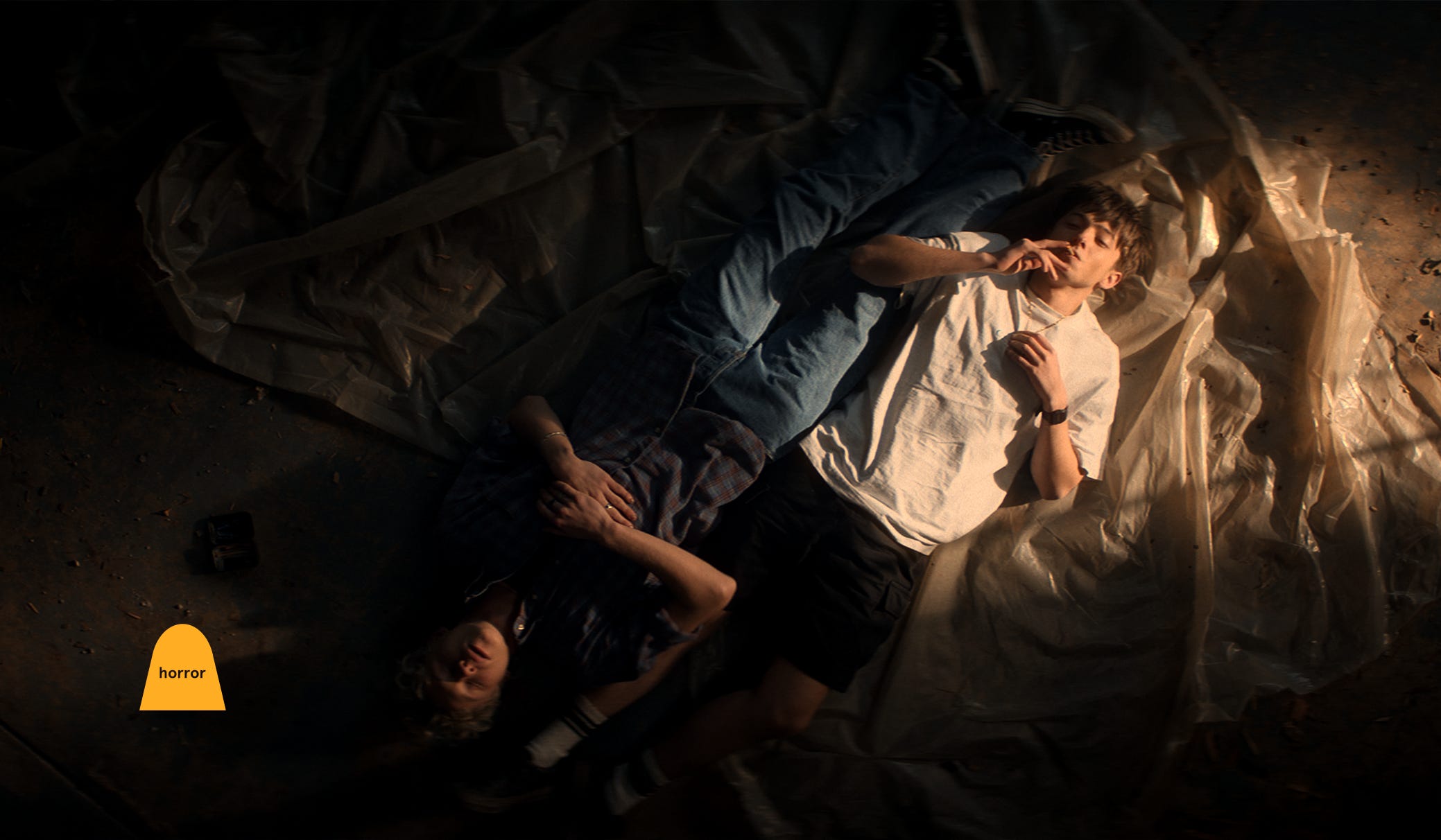
In the back of a bus, Naim (Joe Bird) and Ryan (Stacy Clausen) sit shoulder to shoulder. As if some force pulls them together, they begin to nestle into each other before softly kissing—and then more than kissing. It’s a moment of tenderness between two gay teens that should send the heart fluttering, but with the rules established in Leviticus, it feels dangerous. Earlier in the movie, the boys are subjected to a kind of religious conversion therapy. However, instead of trying to pray the gay away, a mysterious preacher tries to scare them straight by performing a ritual that attaches what could only be described as a demon to them. And that demon takes the form of their greatest desire: each other.
That’s why on the bus, their act of queer love, a moment any closeted gay teen wishes for, is a risk. It is exactly what first-time director Adrian Chiarella wants you to feel. Whether it was something you experienced or something you’re seeing from the outside, Leviticus preys on the fear and shame that many queer people experience from an early age. It’s refreshing to see a direct exploration gay emotions when horror very often gestures towards queerness but rarely fully embraces it, especially as frankly as Leviticus.
Naim and his mother Arlene (Mia Wasikowska) recently moved to a small industrial town in a rural part Victoria, Australia. Endless power lines and abandoned factories add to the dreariness for Naim, who can’t seem to find much to be excited about in the dusty ruins. It also doesn’t help that a good chunk of the town teeters precariously on the edge of religious fanaticism. That is until his handsome (and sometimes deliquent) classmate Ryan invites him to explore the outskirts of the town.
The pair finds themselves in an abandoned factory. They talk shit, they wrestle around, and then they find themselves kissing like it’s the most natural thing in the world. A virtue of Leviticus is that although it is about a raw and devastating part of the queer experience, it never relies on the teen angst tropes of coming out. Instead it uses presents itself as an allegory of the queer experience that asks you to feel rather than experience. As they’re kissing, Naim notices something out of the corner of his eye that startles the moment and sends them crashing back into reality into their small dreary town once again.
The boys can’t keep their eyes off each other in the small congregation that seems to encompass most of the town. Even before the supernatural elements come in, there is a sense of danger. The pastor (Ewen Leslie) keeps a watchful eye over his flock, and Naim feels it like daggers in his back. Eventually, the paradise that Naim and Ryan created in the ruins of their small town dissipates when their proclivities are discovered and they’re forced to undergo a kind of conversion therapy at the hands of a “deliverance healer”.
At first, the moment is played for laughs.
“What do you feel?” the healer asks.
“It’s a little cold,” responds Ryan.
“There’s divinity at all temperatures.”
But quickly, darkness settles in as the boys see something that forces them to repress their desires deep into themselves. However, these are two boys in the throes of first love and keeping away is like ceasing to breathe. So, the choice is set: choose love or choose death. Perhaps the metaphor is blunt, but it’s effective nonetheless. When Naim watches Ryan follow an invisible specter into a photobooth, he’s at first upset by the sounds of pleasure and then horrified by a sudden violence that sends Ryan reeling away from him.
Chiarella weaponizes that push-pull between love and shame, and fear and joy. How can something that feels so natural be so demonized? There may not be much more to the movie than that, but like It Follows before it, the sense of dread is remarkably effective in fueling the horror for its perfectly-tuned 88-minute runtime. And yes, horrors are sown. It often feels more akin to a possession movie than anything, apt considering it’s Christian connection.
Australian horror, like Talk to Me and The Loved Ones, are known for their dour tone and unflinching violence, something Leviticus has in spades. The paranormal attacks by the entity are equal parts surreal and downright horrifying as the boys are hit, thrown, and maimed and increasingly brutal ways. Once the boys learn that the entity physically looks like the other, there’s always a sense of danger when they’re together. And we’re as tuned into the risk as they are.
However, like Naim and Ryan, we want them to be together as much as they need to stay apart. Which why the scene on the bus holds so much emotional weight. In my heart, I felt so warm and at times jealous at the open display of love at such a young age. But in the back of my mind I kept thinking, “what if this is wrong?” Of course, in the context of the movie it’s the supernatural danger. But I’ve felt it in my real life. The sensation of being watched, perhaps judged, and admonished.
There’s a simplicity to Leviticus that’s refreshing, especially as horror is expected to be deeper and meaner. The scares are effective and visceral, a testament to the star-making performances by Joe Bird and Stacey Clausen, who perform the invisible attacks with an intensity that makes you feel every strike. It is a terrifying film that is unrelenting in its intensity. It is fast paced in a way that other films in the genre aren’t. At times it’s at the expense of further depth, but the film firmly sets itself as an allegory meant to be felt rather than consumed.