


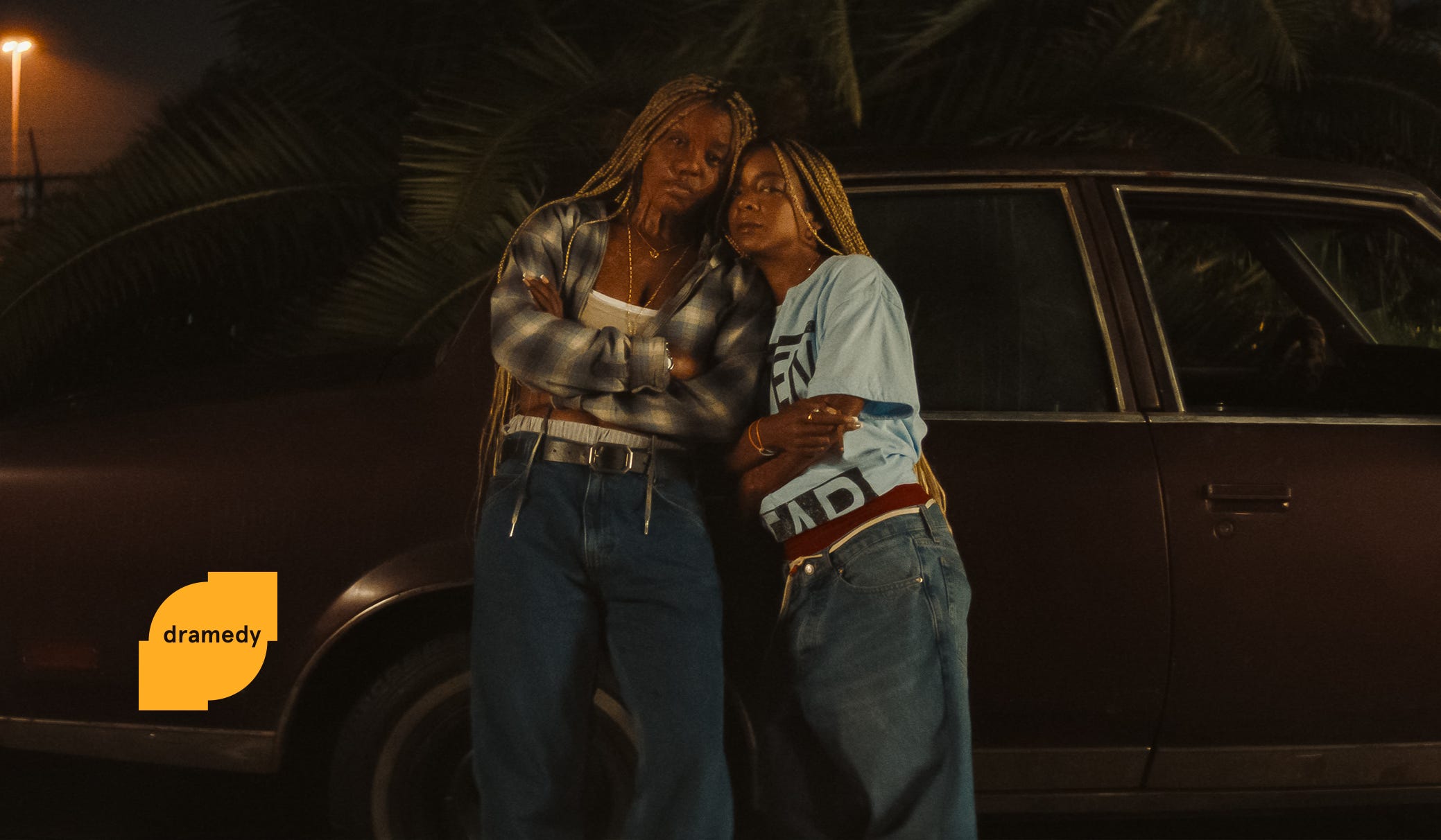


Is God Is is a roaring tale of revenge that balances the epicness of a Greek myth and surreal crowd-pleasing antics of a blaxploitation noir with the intimacy of a family drama. The result is a genre and expectations-bending odyssey through trauma and its cascading effects across generations. Hilarious but incisive in its reclamation of female rage in the face of patriarchal violence. You’ll laugh. You’ll cry. You’ll cheer. You’ll want to rage against the machine. One of the year’s very best. (★★★★)
Is God Is is in theaters Friday.
“Make your daddy dead… real dead.”
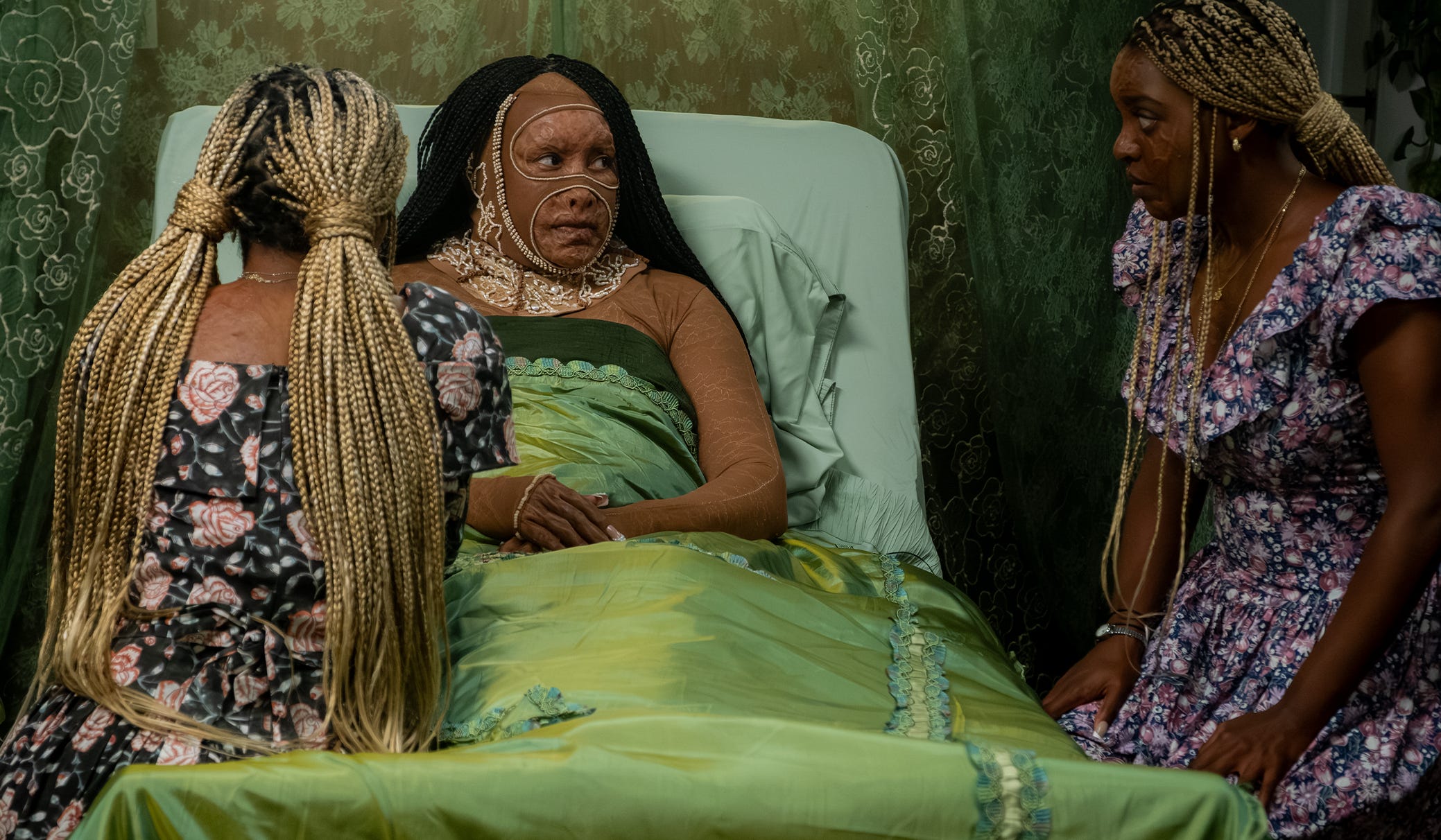
Is God Is is as simple as that. The line, perfectly delivered by the legend Vivica A. Fox, sets our heroines off on a classic western tale of revenge. But the world isn’t as straight forward as it seems. There’s a mythic quality to how writer-director Aleshea Harris presents Ruby (Fox) for the first time. She’s laid on a lush bed surrounded by greenery and lace like an earth goddess, there are women braiding her long hair with reverence, and her face is covered with a mask hiding burn scars from a devastating attack that left her twin girls Racine (Broadway legend-in-the-making Kara Young) and Anaia (newcomer Mallori Johnson) thinking she was long passed. But she’s very much alive, and mad as hell.
The incident also left scars on Racine and Anaia’s bodies that led to a life of suffering that has driven Racine to anger and Anaia to introversion. Despite their difference in demeanor, they share a unique emotional and spiritual bond. They even at times talk telepathically, shown to us cheekily as subtitles:
“If I’m dumb, you dumb. If I’m weak, you weak. Because we come from the same fucking cell bitch.”
Even their sisterly bickering comes telepathically, a shared frequency that has kept them alive through years of trauma. But that frequency is abruptly hijacked when they reach their mother’s bedside, where her dying wish transforms their spiritual bond into a singular, violent mission.
As the screen bleeds into a dusty sepia, signaling the film’s shift from surreal comedy into a vivid Spaghetti Western, Ruby tells the girls the real tale of the attack: In their quiet suburban home, Ruby senses a shift in the air. After mounting tension, a voice pierces the silence of the house. We never see the intruder’s full face, though his disconcertingly composed voice is more than enough to gather what we need to know about him. He’s charming. He’s convincing. And deranged. That man, only known as “The Monster”, is the twins’ father. In an act of violence, he sets Ruby ablaze with the twins nearby.
Is God Is is a question and a statement.
“Is God?”, questions the presence and place of powerful deities in our lives. And “God is”, cements our relationship and reaction to those deities. God is kind. God is evil. God is merciful. God is destructive. Racine calls their mother God, because she is their creator. It’s part of the reason she is so motivated to carry out her wish. But if that’s true, doesn’t that also make their father a God? Why, in a world with such a force of good, is there such evil? Harris doesn’t answer these questions, but she posits how that tension manifests itself in the lives of women, specifically Black women, in a patriarchal society.
The twins set out on a journey west to California, tracing The Monster’s movements after the attack by connecting the people left in his wake. The first is Divine the Healer (Erika Alexander), “the lady he took up with” after the attack. Alexander, best known for her comedic roles in Living Single and American Fiction, finds humor and mournfulness in her religious delusion. She sanctifies The Monster and sees him as an imperfect but unimpeachable deity. She testifies in front of a small but, ahem, passionate congregation that throw their bodies around the room with each word of her testimony.
While Divine burns with the flames of religious fervor, Racine and Anaia stand by deeply unimpressed. Their stillness in the face of Divine’s chaos highlights the precarious balancing act between surreal comedy and the deeply real and devastating after effects in violence towards women. This is where Is God Is finds its teeth. The film lives in the uncomfortable space between comedy and tragedy. Divine’s testimony is hilarious right up until you remember she is worshipping a man who set his ex on fire with his children there to witness his brutality.
Harris forces the viewer to navigate that tonal whiplash. She makes your laugh one second and then recoiling the next before asking, “what’s so funny?”
It’s not easy to define Is God Is. In some moments, there’s an intensity to the action that Harris presents like a taut thriller. The movie is gripping when the twins are perused by a motorcycle-helmeted anonymous assailant, who ends up being someone just as impacted by The Monster’s abuse. It makes you forget that the movie was based on Harris’s play of the same name. As a first-time feature director, her ability to make her work cinematic is impressive. The epic, scorched wide shots of the deserts of the west cut with emotive close-ups giving insight to the girls’s unique inner monologues make it hard to discern exactly how any of the movie was mounted on stage.
The closer the twins get to confronting The Monster, the more looming and darker his shadow becomes. However, it also begins to make Anaia question whether their mission is actually a justice or if it makes them as bad as him. She asks,
“We come from a man who tried to kill our mama and a woman that wants to kill him.”
Is God Is directly confronts the trauma cycle that comes with abuse, especially at the hands of the patriarchy. While he’s known as The Monster, what does that mean for the people that come from him—and the people that choose to be around him. In a searing one-scene performance, Janelle Monáe challenges both the twins and our idea of who is to blame for someone’s bad deeds. As his current wife, Monáe finds joy, sadness, and rage in her current situation that is juxtaposed and challenges by their girls’s own experience in the fallout.
Like the shark from Jaws or John Doe Se7en, Harris only ever shows the movie’s villain in extreme close-ups or in quick flashes of his misdeeds. Sterling K. Brown, an actor well-known for his charming and amiable personality, weaponizes that very warmth here. It is a reveal worth the wait, both for Brown’s blazing performance, but for the energy it brings to the movie.
For years, stories felt obsessed with the idea of difficult men: Don Draper, Walter White, Tony Soprano.
But those stories try to find empathy for those men, presenting them as anti-heroes meant to be root for despite their mistakes. Harris makes the bolder choice: she allows The Monster to be a monster. He isn't weak, he isn't misunderstood, and he hasn't “learned his lesson.” By refusing to subvert our expectations of his cruelty, Is God Is allows its characters to full rage against their circumstances, even if at times that rage can, like a fire, burn out of control.
Is God Is doesn’t fully fulfill the expectations you have for any one of it genres. Just like the response to trauma—violent or generational—it’s messy, confusing, and sometimes your reactions don’t make any sense. All of those feelings are balled up in a riotous and roaring odyssey that is as funny as it is heartbreaking and incisive as it is thought-provoking. With Young and Johnson’s powerhouse performances keeping you entertained and engrossed and assured directorial hand from Harris guiding you like an unseen fate, Is God Is is one of the year’s very best.


