


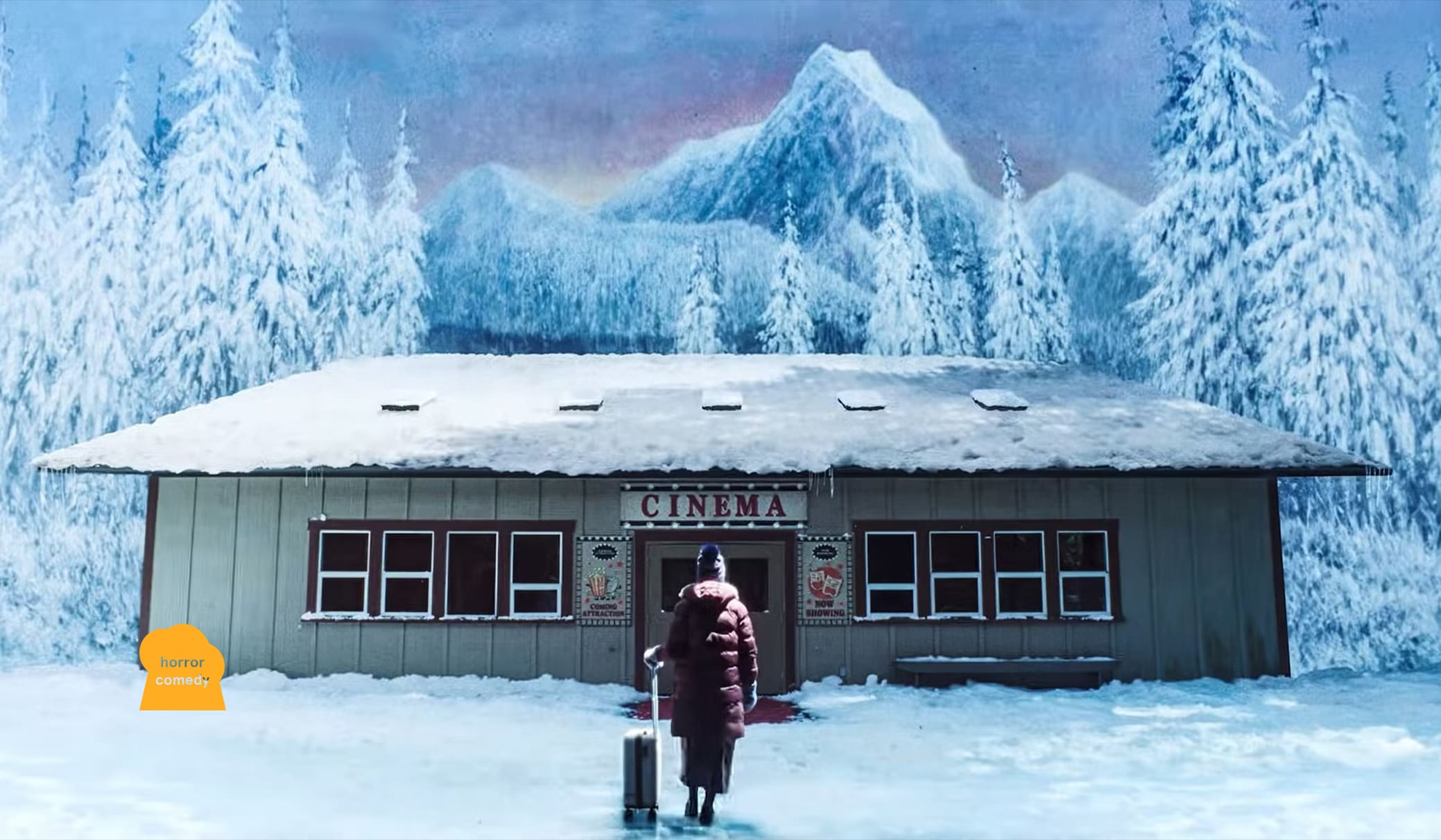
Since the turn of the century, there was a shift in the slasher genre from gorier and meaner remakes of old classics (Rob Zombie’s The Texas Chainsaw Massacre, Friday the 13th) to critical love letters of the genre (The Cabin in the Woods, my underseen fave The Final Girls) to re-quels (2018’s Halloween) to meta-requel satirical homages (2022’s Scream). And somehow, Jane Schoenbrun’s Teenage Sex and Death at Camp Miasma exists between and above and outside all of those eras. At once it is an homage to slashers, an incisive takedown of their relationship with sex, a probing (literally at times) exploration of queerness in and around the genre, and a Hollywood satire. It is a tall order for a movie that is obsessively a weekend-long conversation between two women—a young queer upstart director (Hannah Einbinder) and the now middle-aged star of an 80s slasher franchise (Gillian Anderson).
But that conversation eventually transcends time and space and reality in a way that we’ve not quite seen the horror genre take.
Twin Peaks or Mulholland Drive are the best examples, but neither of those David Lynch classics are quite as generous with their thoughts as Schoenbrun is. The “Camp Miasma” franchise, a direct homage to the Friday the 13th series, has led to a sprawling series of movies, comic-books, action figures, all playfully hinted at in the movie’s opening credits sequences. Though it was schlocky and problematic by today’s standards, it has its devoted fans like Kris (Einbinder), who, with a major movie studio behind her, is rebooting the franchise. Kris hopes that Billy Presley (Anderson), the reclusive final girl of the first movie in the franchise, will reprise her role. To convince her, her agent (hilariously played by Sarah Sherman), sets up a meeting between the women at Billy’s house… failing to mention she lives on the grounds where the original movie was filmed.
There is a storybook quality to the way Schoenbrun presents the world of the movie. Our world is almost more surreal than the world of the first “Camp Miasma”, that we dip in and out of throughout the movie. The watercolor sky and and sprawling forest feel like a set. And perhaps it’s because the real performance isn’t in the movies, but in our reality. When Kris first encounters Billy, she sweeps in like a mythical figure. And to Kris, she very much is. It probably helps that Billy talks in near-riddles and when they sit down for dinner, she turns around from the kitchen in a flowy robe holding a tray of fried chicken from KFC bathed in some spotlight coming from who knows where. A goddess among mortals, and that mortal being Kris. Their conversation goes how you’d expect any conversation to go between an ardent fan and the subject of the fascination. However, Billy is more interested in Kris than she is in the project.
While Billy could easily be mistaken as a delusional Norma Desmond in Sunset Boulevard-esque figure, she feels that the “Camp Miasma” franchise helped free her from her shackles of shame.
If Billy is freed from shame, then Kris is burdened by it. She avoids the topic of sex and even hopes to correct the sins of the movie by modernizing its sexual politics. However, for a person that should be as sexually liberated as Kris is, she’s surprisingly shy of the subject. Even when she talks about her polyamorous relationship, it’s like she’s outside of it. I mean, she is literally outside of it in her own relationship. Her partner Mari (Jasmin Savoy Brown) has a boyfriend… who is only dating her. Basically, Kris is a cuck.
As the movie continues to unravel in hypnotic vignettes that alternate between scenes of mass carnage from the “Camp Miasma” movie—one scene finds Little Death (this universe’s version of Jason Voorhees who is marooned at the bottom of a lake waiting to be brought back from death) tearing through a group of hapless camp counselors set to the song folk rock ballad “A Long December”—and the probing conversations between Kris and Billy, it becomes clear that Teenage Sex and Death at Camp Miasma isn’t about horror, it’s about what draws us to horror: pleasure.
Horror, and slashers in particular, have been held dear by queer people. But why when it so often villainizes us?
For years, slasher villains have been what the societies they existed in would classify as deviants—Norman Bates cross-dressing in Psycho, the transsexuality twist in Sleepaway Camp. However, it’s intentional that Camp Miasma chooses Friday the 13th as its foundation. In that movie, sex is seen as unmoral and punishable by death. How do you reconcile that with the queer tenet of sexual freedom? Well, of course, it’s because the opposite of freedom is not imprisonment, it is shame. Slashers weaponize that feeling shame. Of choosing to do something purely for your own enjoyment and “selfishness.” It’s choosing to eat a tray of fried chicken instead for dinner or reaching for a pack of sour gummy worms. It’s experiencing pleasure or relishing in pain.
If that sounds like a lot, it is. Camp Miasma is a feel everything movie. The way that it traverses through multiple genres—horror, romance, Hollywood satire, comedy—is hard to grab a hold of, but once you do it’s impossible to leave it. In some ways, it’s cinematic ASMR the way it scratches an itch you didn’t know you had, an itch that only Schoenbrun’s unique brand of surrealism—sure to become its own genre like Lynch and Cronenberg—can scratch. It’s like she’s solved dream logic and captured it in vivid 35mm. It helps that Gillian Anderson is giving one of the most captivating performances of the decade as she acts as a sort of sexual and creative muse in what is quickly becoming Kris’s story.
Once the line between Camp Miasma and “Camp Miasma” becomes blurred, the movies reaches its mind-blowing, wholly satisfying climax.
In French, orgasms are called “petite mort” or little deaths. Teenage Sex and Death at Camp Miasma literally asks, why not let those little deaths in? Jane Schoenbrun presents the world not as it is, but how we can perceive it to be. Magical, colorful, a little perverted, but for us. Sure, what if we can be killed for our pleasure? So be it. In that death is just even more pleasure. To call Camp Miasma allegorical would be belittling, because it’s more than taking a feeling we understand and presenting it in a way we can relate to. It’s taking a feeling we’ve never understood and turning into scripture. This is the bible for your perverted little horror freaks—and I am one of you.
More queer horror:
Gay horror 'Leviticus' finds terror in shame

In the back of a bus, Naim (Joe Bird) and Ryan (Stacy Clausen) sit shoulder to shoulder. As if some force pulls them together, they begin to nestle into each other before softly kissing—and then more than kissing. It’s a moment of tenderness between two gay teens that should send the heart fluttering, but with the rules established in