



La Bola Negra is about time. While it spans three separate time periods with different characters, their lives are intertwined, both literally and figuratively. The mystery of how those threads interact is compelling enough. War, music, and romance are ingrained in the story and presented with as much grandiose as the highest-budget Hollywood movie. However, writer-directors Javier Calvo and Javier Ambrossi, affectionately known as “Los Javis”, have more on their minds.
Following a spectacular vaudevillian musical number for the nationalist army, Nené (Penelope Cruz) talks to young soldier Sebastián (musician Guitarricadelafuente in an electrifying film debut). She talks about the freedom in Madrid. The kind of real freedom that the fascist nationalists wouldn’t understand. She talks of the artists and performers and her friend, a trans woman, who said, “Transvestism is the fantasy of possibility. War is its opposite.” You can even see the inspiration from drag culture in Nené’s performance. It’s those small gems of the philosophy of queer freedom hidden in La Bola Negra that make it such an overwhelming achievement.
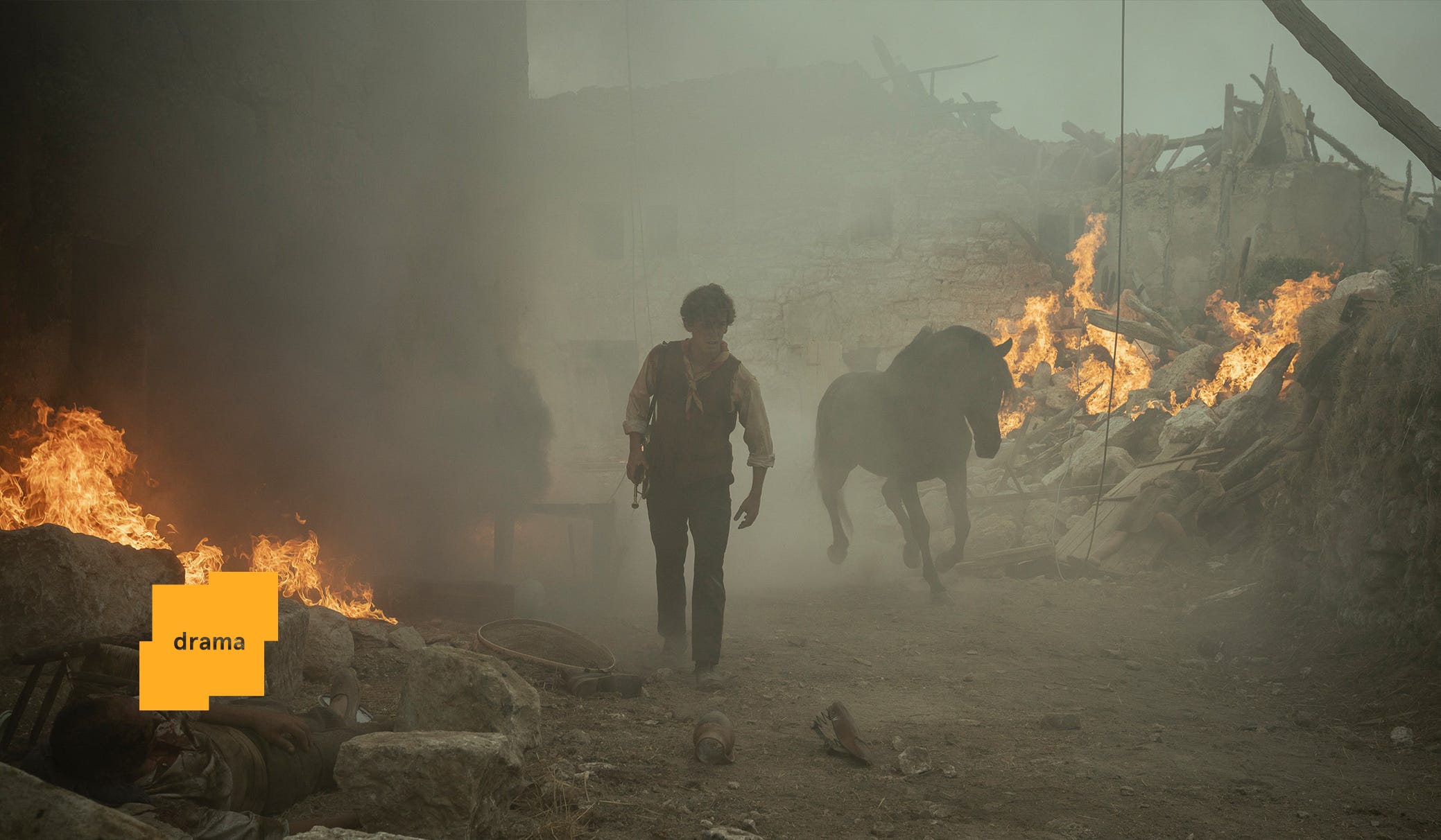
There are harrowing scenes of war, like the riveting opening sequence that catalogues the Italian army’s attack on a small village, despite the citizens’ allegiance to their cause. Bullets rain down on innocent bystanders by fighter planes. Bombs sow carnage on the winding streets. Amid the chaos is trumpeter Sebastián, who makes his way out in a harrowing escape only to be captured and given a choice between death and the army. Once he is in the army, he feels out of place amongst the machismo. That is, until he is tasked with guarding handsome prisoner Rafael (and I mean, movie star dreamboat handsome played by Elité’s Miguel Bernardeau), whose presence begins to stir new feelings in him.
La Bola Negra lives in the juxtaposition of opposing philosophies—creation and war, love and hate, queerness and tradition.
In 1932, Carlos (Milo Quifes), a young man from a wealthy family in Granada, is stunned by being blackballed by a local members-only club. The club’s gatekeepers, a group of politicians and clergymen, vote on a man’s worthiness of joining by choosing a white ball, a yes, or a black ball, a no. The crispness of the sound of each ball rolling down a track to be counted feels like a death march. However, it’s unclear whether it’s a death march because Carlos is afraid of being rejected or afraid of being accepted. He’s ultimately rejected for rumors of his homosexuality, which sends him reeling into a drunken stupor that culminates in a hypnotic dreamlike dance sequence in a local pub captured sumptuously by cinematographer Gris Jordana.
In 2017, gay writer and historian Alberto (Carlos González) receives word that his grandfather, who he didn’t know existed, willed him a series of papers. The discovery sends him diving into his family’s history—and butting heads with his complicated mother (Lola Dueñas)—to connect the three threads of the story.
Los Javis stitch the movie together with musicality, allowing each thread to bleed into the next.
The clacking of the white and black balls in 1932 continues to play over scenes of dead bodies hauled from the destruction of war in 1937. Military action is humorously interrupted by the sound of a Grindr message in 2017. It’s a rhythm that makes the movie eminently watchable. Though there are moments of slow tenderness. Sebastián, in a series of encounters with Rafael (played with gravitas by Elité’s Miguel Bernardeau), slowly discovers his sexuality. He begins to see himself in Rafael. Their would-be relationship buds with tension but also tenderness as Rafael begins to understand Sebastián in return.
One of the themes of La Bola Negra is recognition. The way, through centuries, queerness can be recognized by queerness. It’s pulled together in a post-script in a surprise appearance by Glenn Close as a visiting author that Alberto seeks out to help him solve the mystery of his grandfather. She helps bring the movie’s ultimate theme to the surface: Who will carry our stories on when we’re gone?
There are vivid scenes of the carnage of war, dazzling musical numbers, and dramatic twists and turns. It is an impressive and engrossing watch that could be a strong movie on those technical merits. However, there’s something at its core that we haven’t seen in a movie of this scale: small acts of queer freedom. Yearning to reach for a lover, kiki-ing with your boyfriend on FaceTime (as Alberto does with his boyfriend in a delightful cameo by Julio Torres), and recognizing yourself in a female icon. Those acts weave themselves into the story’s DNA, transforming it into a moving spectacle we’ve never quite seen before.
La Bola Negra is a tragic love story, a historical war epic, a coming-of-age story, and a family drama.
Yet, it feels like every one of those threads is necessary. It’s like a perfectly composed piece of music. Every note has its purpose, and every purpose has a note. Los Javis conduct the piece with the kind of astonishing bravado that we don’t see in our movies anymore. There are monumental full orchestra blares balanced with soft, sentimental moments—like a melancholic trombone trying to drown out the chaos of the world. When it all comes together in a beautiful finale, it all makes sense. The emotions wash over you all at once, and you understand the gravity of what you’ve just been listening to. It’s our history.

More from Cannes:


